Failing to Notice


In an email conversation with a friend last week, I was challenged to consider the idea that maybe I take life a bit too seriously. Perhaps I should lighten up, think a bit less, turn off my mind and just enjoy certain things without examining their deeper meanings or subconscious influences on my life. Now this friend didn’t say these things or challenge me to do so, but the course of the conversation led me to consider these things myself.

I’ve been in a season of reflecting on the question, “God, what in the world am I doing here?” and to have someone who’s not in my head ask the same question was disheartening to say the least. It caused the question to move from a philosophical inquiry to a full out examination of how I do life and teaching and ministry.

But this morning I read a “knot” by R.D. Laing while doing some research for class, and it confirmed for me that, in this case, to follow the masses would be the worst plan for me and completely counter to everything I’ve spent the last decade of my life working to change in my life.

The range of what we think and do
Is limited by what we fail to notice.
And because we fail to notice
That we fail to notice
There is little we can do
To change
Until we notice
How failing to notice
Shapes our thoughts and deeds.

There seems to be an epidemic of failing to notice in our society today. But the more time I spend reading and trying to share what I am learning about learning and thinking and intentional living, the more I see that, for many, the problem isn’t just not knowing. The problem is that many do not want to know. Because to know is to reflect, and to reflect is to critique. And often, to critique means to change. And change is a double problem, because to change, one must first admit they were wrong and must second work hard to discover the error and correct it.

Ignorance truly is bliss. But for the believer, to live in ignorance is to live in disobedience. To be created in the image of the omniscient God is to possess an inherent curiosity, a desire to both know and be known.

So how do we begin to think and to know in a world that emphasizes being known at the expense of knowing anything beyond ourselves?

Today, I believe I will just say that a first step would be to simply begin noticing just how much we fail to notice each and every day. From the mundane to the grandiose, there is so much we fail to notice around us.

Today, I believe I will simply stop and notice.

Children’s Books, God’s Sovereignty and Man’s Free Will


The last couple of years I have taken to reading youth fiction. It’s a great balance for the heavy reading I do for school, and I love revisiting books that I read as a child. They take on a whole new meaning as an adult. A truly gifted writer is able to weave together multiple, complex themes, and some of those themes are only visible after time and maturity grow us up a bit.

The Chronicles of Narnia are a prime example. I read them two summers ago for the first time since I was in the 5th grade, and they came alive to me in a completely different way than they did when I was eleven. It is a treat to be able to go back and glean deep theological truth found on such simple terms. To describe God in the words of a child is a literary skill I envy.

While on vacation a few weeks ago, I found a copy of Madeline L’Engle’s book A Wrinkle in Time at a thrift store, and I purchased it. Her writing intrigued me as a child as well, and I looked forward to reading it through the lens of adulthood. I’m finishing it today, and I as I read the conversation below, it struck me as such as simple yet profound way of describing the concept of God’s sovereignty and humanity’s free will working simultaneously in harmony with one another. Being fiercely independent, the concept of God being in complete control and me still having any choice in the matters of my life never really meshed, but this makes sense to me.

“In your language, you have a form of poetry called the sonnet.”

“Yes, yes…”

“It is a very strict form of poetry, is it not?”

“Yes.”

“But within this strict form the poet has complete freedom to say whatever he wants, doesn’t he?”

“Yes… You mean your comparing our lives to a sonnet? A strict form, but freedom within it?”

“Yes. You’re given the form, but you have to write the sonnet for yourself. What you say is completely up to you.”

I tend to think that either I’m in control or someone else is. But God is pleased to work with us, within our lives. He has given us the structure in which He desires us to work. God gives us a range of choices for our lives; “This is the will of God for your life…” But within that strict structure, we are free to create a masterpiece or a trainwreck of the sonnet he has asked us each to write.

Seems to me, in my simple human mind, that this may be a good way of describing how God works in our lives. God gives us choices in life, any of which He would be pleased with. He has given us boundaries in which to live, guidelines to follow, and reason, knowledge and logic with which to make decisions.

And considering we are told in Ephesians that we are God’s handiwork, His masterpiece, I don’t have a problem at all with the idea of my life being a sonnet. Or a Haiku. Or any other type of art in which the artist is required to express his or her genius within certain boundaries. In fact, I believe expressing yourself within a set of externally given guidelines is more beautiful and more challenging than just “freestyling” whatever comes to mind.

So I guess the only question is: what is your sonnet going to be about?

The Sins of Our Youth


Remember not the sins of my youth or my transgressions; according to your steadfast love remember me, for the sake of your goodness, O God! Psalm 25:7

This was the daily verse that appeared in my Twitter feed this morning. Thinking on some things I knew were coming up today, I was reflecting on the past a bit, and I was in a regretful frame of mind. My knee-jerk reaction to reading it was, “‘Remember not the sins of my youth.’ That must be nice. I can’t seem to get away from them.” Not exactly a heart of thankfulness to a loving and forgiving God, but I’ll blame it on the fact that I hadn’t had my coffee yet, and being awake definitely helps my spiritual well-being.

There are times in which it would be nice to be able to forget the sins of our youth. Some choices we make really do stay with us for a lifetime, even when we want to shake them off, be free from them and literally move on. But what we must remember is that Christ, by remembering not our sins, does allow us to move on. Those choices cannot be changed, and the consequences remain, but there is freedom from the condemnation of those sins. The word remember here isn’t the opposite of “forget” but means “don’t hold it against me”. The psalmist is saying, “I’m not that person anymore, please don’t hold my past over my head anymore.” And he makes a case to God for why God should not hold his sin against him.

First, the psalmist says that God’s love is everlasting. A loving God forgives sins, never to bring them up again. “Love covers a multitude of sins” (1 Peter 4:8). Isaiah says that in God’s love he took our sins upon His back, delivering us from a pit of destriction (Is. 38:17). Love doesn’t throw us back in the pit.

Second, the psalmist tells God that no longer holding our sin against us is for the sake of His goodness. How is forgiving our sin good for God? One way is that it enables us to join Him in His work. Now, does God really need us to do His work? No, but in His plan, He asks us to join Him in His Kingdom work. Makes sense to me; work is always easier when you’re doing it with people you love. But what the psalmist is saying is that, when our sins are forgiven and we are able to stand up from underneath their oppressive load, we can then take upon ourselves His easy load of service for the Kingdom. We can’t carry our sin and His Kingdom simultaneously. When we allow Him to take the sin, and the accompanying secrecy, shame, guilt, condemnation, it frees us up to serve Him like He has called us to serve Him.

A prime example of this is found in the life of Peter. I relate more to Peter than to any other person in Scripture, and he is a great testimony of being set free from the sins of his youth for the ultimate goodness of God. In Luke 22, Jesus tells Peter, “Simon, Simon, behold, Satan demanded to have you, that he might sift you like wheat,  but I have prayed for you that your faith may not fail. And when you have turned again, strengthen your brothers.”

Jesus knows that Peter is about to fail Him miserably. He says, “I’m praying that you won’t. But when you do…” Have you ever had a conversation with someone like that? Has anyone had that conversation with you? “I’m warning you. I know where this is headed, and it’s going to be bad. I don’t want you to, but I know you’re going to anyway.” That’s pretty much what Jesus tells Peter.

But He adds something to the end of the statement. He adds hope and purpose to the failure. He tells Peter, “And when you have turned again, strengthen your brothers.”

So why does God forget our sins but not allow us to? One reason is because we can’t use past failure to connect with and strengthen others if we act as if it never happened. God trades in our beauty for ashes, He restores the years the locusts have eaten (Joel 2:25), and He works all things together for our good and for His glory (Romans 8:28). And for Him to be able to make the worst decisions of our life beneficial, they must be exposed to the light and applied to the lives of others.

My ashes couldn’t have been traded for beauty if there hadn’t been people who had previously been sifted by Satan like wheat and then obediently strengthened this sister. Same goes for me. When I want to forget my times of sifting and “move on” with life, I remember that those times are a waste if they are not used to strengthen those behind me who are still spinning from their own sifting.

So I am thankful that God remembers not the sins of my youth. But today I am equally thankful that He makes sure I never forget them.

Do You Know the Author?


Oh, continue your steadfast love to those who know you, and your righteousness to the upright of heart! Psalm 36:10

I love reading books and articles by people I know personally.

While any good book is worth reading, the experience is more enjoyable when I know the author because I can see little bits of them in their writing.

I discovered this in seminary when most of my professors had books that they had penned on the required reading lists for their classes. As the semester would progress and I got to know the professor better, I would catch myself reading with their voice and inflection in my head; almost my own personal book on CD. I still get tickled reading portions of Dr. Danny Akin’s books and articles and sermon manuscripts because I can tell when he was writing in a particularly passionate way and I can imagine him up on his tip-toes, leaning over the pulpit, preaching away on whatever point he happens to be making in print at the time. Dr. David Jones was my Sunday School teacher at Wake Cross Roads Baptist when I lived in Wake Forest, and when I am reading any of his works, I can imagine my Sunday school teacher right there in my office, explaining with stick figures on a dry erase board whatever mind boggling ethical point he is making in the book or article. Knowing the author and how much of his time, effort, passion and knowledge– how much of himself– went into the project makes me appreciate it even more.

It continues today. I love reading the blogs of friends and when I am researching something for my own writing, I tend to start with the writings of people I know and respect. Because I know them outside of their writing, I have a better context for what they are expressing in their work and it helps me understand it better.

For example, I don’t usually use the commentary provided with the Sunday School material at church (Shhh… don’t tell), but this quarter, Dr. Allan Moseley wrote the commentary on our study of Jeremiah and Lamentations. Dr. Moseley was the Dean of Students when I worked in the Student Life office at Southeastern, and I have heard him preach and speak on numerous occasions. Because I know him, I wanted to read what he had to say about the lessons I am teaching in my class. It’s not that I don’t trust other people who write the commentaries provided; there’s just extra incentive for me because I care about what he has to say simply because I know him.

Same principle applies to fiction. My friend Greg Wilkey recently published an e-book through Barnes and Noble. Greg was my department head when I taught at an area school, he and his wife attended our church for a time and I have been friends with his sister-in-law for several years. This character and book series are his passion, and to see it in print and be able to read it has been a joy for me because I know how much he loves it and how hard he has worked at it. It has been even more fun because, as I read, I am able to see those bits of his heart and soul in the characters in the story; the average reader would simply miss that level because they don’t know Greg. Those who know him much better than I do would probably tell you they love the book even more than I do because they love and know Greg more than I do.

Point being is this: there is a deeper meaning and understanding to any work of art (especially writing) when you know the writer.

The same principle applies to the Bible. The more you know and love God, the more you see Him in His writing, then the more you appreciate the deeper meaning and subtle references to Himself that mark the Word from Genesis to Revelation.

Here’s where most people trip up when reading the Bible– they read it for historical value or as an instruction manual or self-help book. While there are certain components of each of those genres of writing in the Bible, it is, more than anything else, an autobiography. It is God’s story of Himself to, for and concerning His people.

If you read the Bible and don’t understand it, or you think it’s boring, try reading it first as God’s autobiography. Approach it with the attitude of wanting to first learn all you can about the Author. You will find Him in every story, every law (even the weird ones like the ones about mold removal and sleeping with your clothes on), every piece of instructive teaching, every prophecy. Read it through the filter of this question: What can I learn about God? Get to know the Author. Learn about how much He loves His readers. Learn about the heart behind the writing of the book. Find out about God’s passion and it will become your passion. The more you know the Author, the more you will appreciate His Writing.

The catch with the Bible is that, because it’s first and foremost an autobiography, you have to read it to get to know the author. So read it, even if you don’t always understand it. Read it and compare it to the “writing” God has done in Creation. Read it and ask other people you know about it. If Oprah can start a world wide book club, surely you can ask a friend what they think about the Book you’re reading.

But before you write it off as history or myth or boring or impossible to understand, make sure you know the Author, because sometimes, knowing the author makes all the difference in your reading experience.

Wandering Away, Crawling Back, and Boot Camp Bill


I started a 30-day Boot Camp Challenge last week. We meet at 5:30 in the morning. Already these two things mean there are two strikes against me. I have not exactly been what you would call “intensely active” the last couple of years, and I have NEVER been a morning person. But God has been continuously convicting me of the fact that my inside and my outside need to match; consistent, healthy discipline of my body is a reflection not only on me, but on my God. And if I stand before people and claim to teach His Word, I need to represent Him to the best of my ability, mind, body and spirit.

So off to Boot Camp I go to kick start myself from “Fat Former Athlete” to “Healthy for Jesus”. It was a rough start. Our instructor’s name is Bill, and I call him Boot Camp Bill (in my head, of course; I make up stories all of the time) because it reminds me of Bootstrap Bill on Pirates of the Caribbean and I need to think of things I like when I work out that early in the morning. But that’s another story for another day. Anyway, Boot Camp Bill comes by my station the other day to encourage me while on the Bosu ball. He wants me to do squat jumps on the Bosu ball. First time through, I just wanted to stand on the Bosu Ball. But on the second set I had the form and technique down and was keeping up pretty well. In his attempt to encourage me he said, “I am so impressed with how quickly you’ve caught on! Usually, people’s first day is really rough; there might just be an athlete in there yet!”
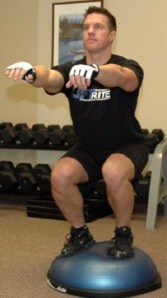
What he meant as a word of encouragement crushed me. Then it just made me mad. “MIGHT BE AN ATHLETE?!?” I thought. I wanted to say, “Yes sir, I did cross training programs like this when I trained in the same boat house as the ’96 US Olympic Rowing Team.” Or, “We did circuit training like this every summer I was in high school and we went to the state tournament in basketball.” My self-righteous anger wanted to get off that Bosu ball and show him an athletic thing or two.

But as quickly as I wanted to Bosu him, the Holy Spirit prompted me with a sobering and convicting question: “Bekah, what about you, at this very minute, would suggest to this man that you’ve ever been an athlete?” I started thinking, “Well, I have on college-issued workout clothes, I have on good running shoes, I’m here with two girls I coach with. Heck, I’m here. What non-athlete is going to think working out at 5:30am is a good plan?” Only showing up at 5:30 am had even a hint of “athlete” to anything of who I am right now. So once upon a time I was a competitive athlete? Big deal that I used to work out. So I’m a coach? Big deal that I can tell other people how to play a game. What about me, right now, says athlete? And the answer was, “Nothing.” Not one thing about my 65 pound overweight, struggling to keep up body screamed “Here’s an athlete!” to Boot Camp Bill. So I decided that neither throwing the Bosu ball at him nor crying like a baby and quitting were good plans.

On the way home it hit me; it’s really easy to live the Christian life like I live the athlete’s life. It’s easy to wear the right clothes, say the right things, even teach others how to do it. We can go through the motions and look the part, but never actually live it out ourselves. We rest on the laurels of past spiritual accomplishments, all the while getting “fat and happy” on memories of the good old days when we were once mighty servants of Christ. When we’ve wandered away for a while, like I’ve wandered from the athlete’s lifestyle, and then the time comes that we actually step up and act like a Christian, our feelings get hurt when someone doesn’t expect it out of us. Or worse, they’re surprised to hear us say we are a Christian because our talk and our lives don’t match up at all. When people around us act surprised to hear that we were ever a faithfully walking Christian, we think to themselves, “See, I knew I wasn’t cut out for this Christian thing,” and we leave with nothing but the memories of what we were and the unfulfilled potential of what might have been.

But, contrary to what my current condition may indicate, I was once an athlete, and there’s still an athlete in there somewhere. So I didn’t get my feelings hurt and leave, never to return. In fact, I went back Tuesday and today, and I’m going back tomorrow. Because I know I’ve wandered away. I know I feel my best when I’m pushing myself to improve. And I am going to do those jump squats on that Bosu ball if it’s the last thing I do. And this morning when Boot Camp Bill came around to cheer us on he said, “You know this is hard, but you also know you can do it and you know to push yourself without me having to push you. I can see that athlete in you.” I smiled and just kept doing my squat-to-leg-kicks.

Going back taught me another spiritual lesson today; when we’ve wandered away and begin the crawl back, there is memory there that remembers what to do, and you get back in the swing of things if you just don’t give up. It will take a while for our words and our appearance to match, and some people may not believe it when they see it, but it’s never to late to come back and actually “do” Christianity for yourself. Once you start back doing things for yourself, praying, reading Scripture, confessing sin, praying with and for people, taking those stands for your faith; people are going to be surprised at first. But if you keep it up, you’ll see that flicker of former glory that never really left. The fire of the Holy Spirit never goes out; it just sometimes we just allow it to die down and smoulder.

So if you’ve wandered away, or just gotten happy with where you are and you sat down to enjoy your spiritual rewards a bit early, what do you need to do to get back on track? Are you the “fat former athlete” who’s grown content to look the part but not participate, or are you still faithfully training and running the race? If you’re ready to get back in the race, jump back in. Don’t let where you are now keep you from where you want to be, physically, mentally, or spiritually. We may wander away or just sit down and stop altogether, but we can always get back on track. Boot Camp Bill says so.